How to Run D&D for Kids: A First Game in 45 Minutes
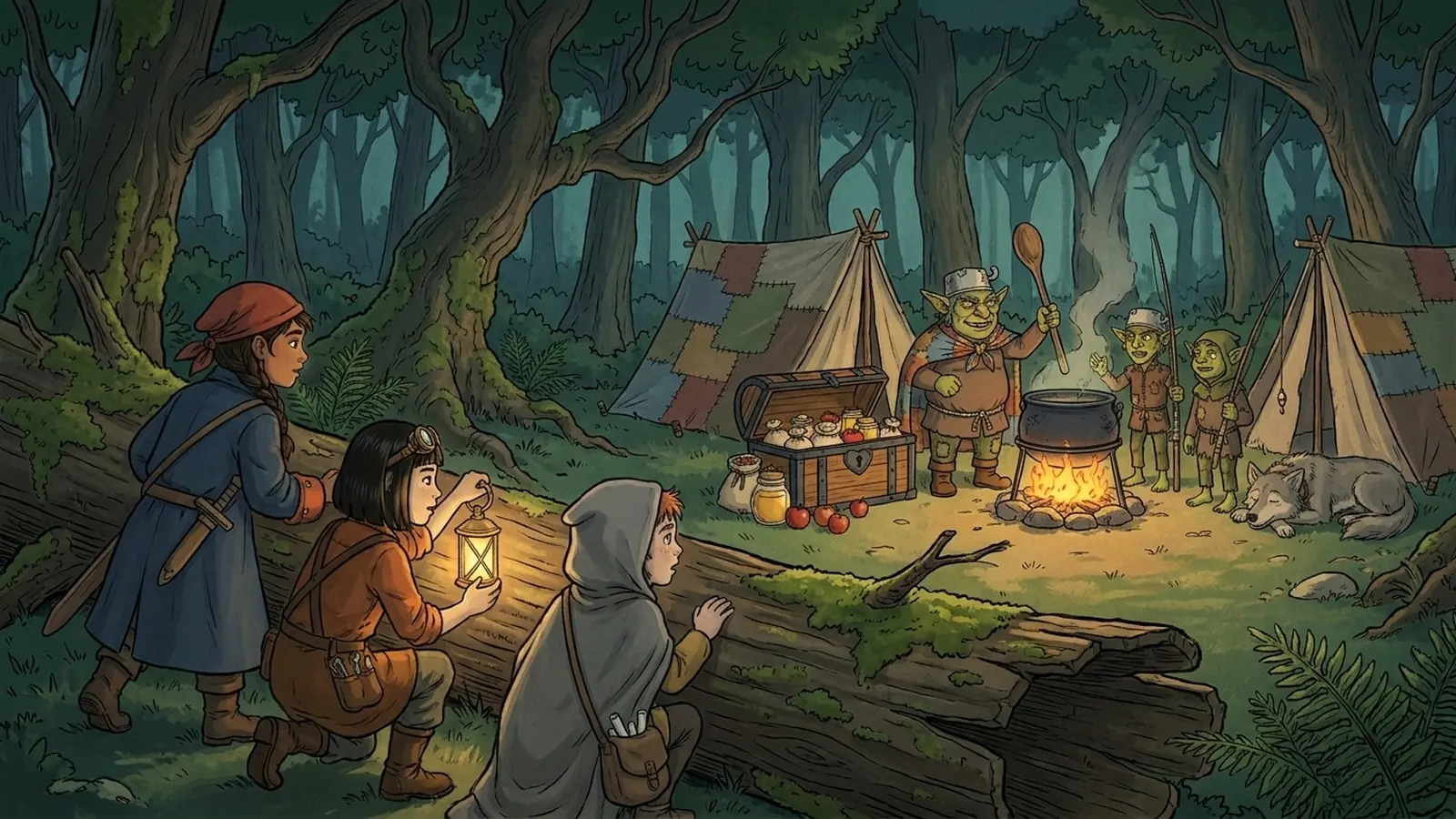
To run D&D for kids, keep your first game short (about 45 minutes, including making characters), hand out ready-made heroes, pick one short adventure with a clear goal, and let the children say what their heroes do while you handle the dice and the rules. You do not need to know a rulebook. You need a story, a few dice, and the habit of asking "what do you do?" This guide is a step by step plan for tonight, built around one of our free tabletop adventures, The Goblin Camp Raid.
A quick note on names: D&D is the tabletop roleplaying game many families start with. Our adventures are not official D&D material. They are free tabletop adventures that work with simple tabletop rules, and they are written for ages 6 to 12.
What you need
- Dice. One twenty-sided die (a d20) is enough for our rules. A full set (d4, d6, d8, d10, d12, d20) is nice for damage rolls. No dice at home? Use the free online dice roller, which rolls everything from a d4 to a d20.
- Character sheets. Print the character sheet page. It has a blank sheet and six ready-made heroes, in US Letter and A4.
- One adventure. For a first game we suggest The Goblin Camp Raid or The Owlbear in the Whispering Woods. Both are gentle and both can end with talking instead of fighting.
- 45 minutes. About 10 minutes to set up, 5 minutes for characters, and around 25 to 30 minutes of play.
- Optional: pencils, a few coins or tokens for rewards, and snacks.
Before the game: pick an adventure and print it (10 minutes)
Choose the adventure first. The Goblin Camp Raid is a good starter. Winter is coming to the village of Millbrook, its whole food chest is gone, and a band of goblins has carried it into Greenbriar Forest. Grandma Tilly asks the heroes to bring it home. The goblins turn out to be frightened rather than wicked, so the story can end in a conversation.
Every adventure page lets you pick how long you have. The Goblin Camp Raid runs from a Quick version of about 15 minutes (2 scenes) to a Full evening version of about 40 minutes (6 scenes). For a first game, choose One sitting (about 25 minutes, 4 scenes) or Long (about 35 minutes, 5 scenes).
Then print the printable guide sheet for The Goblin Camp Raid. Read it once before the children sit down. You are looking for three things:
- The goal. Bring the food chest home.
- The "Read aloud" boxes. Each scene has one. You can read it word for word.
- The guide notes. These tell you what happens next and roughly how hard each roll should be.
If you want the basics in one place, our how to play page explains the whole system on one page.
The first 5 minutes: making characters without math
Skip the numbers. Let each child pick one of the ready-made heroes. In The Goblin Camp Raid, the heroes are Bramble Fenn and Rook Barleymow (Brave), Pip Underbough and Juniper Tallow (Clever), and Wren Ashdown and Mossley Quill (Kind).
Our rules use three traits: Brave, Clever and Kind. Each hero has a point in each one, plus one bonus point in the trait that fits them best, so one trait is +2 and the other two are +1. Every hero starts with 8 Heart Points. That is all a child needs to know.
Then ask each child two quick questions and write the answers on the sheet:
- "What is your hero's name?" (They can keep the ready-made one or change it.)
- "What is one thing your hero loves?" (Bread, cats, climbing trees, anything.)
Practitioner guides for running games with children give the same advice: start from pre-made characters, let the child add one or two personal touches, and keep the backstory to a sentence. The story will build the rest.
Running the scene: ask "what do you do?", say yes, roll only when it matters
Read the first "Read aloud" box. Then turn to a child and ask: "What do you do?"
That question is the whole game. Three habits make it work.
Say yes, or "yes, and". If a child wants to talk to the goblin scout, climb a tree to look for tracks, or offer bread to the camp wolf, let them. Our how to play page says it plainly: it is okay to say yes to a clever idea that is not written down anywhere. The Goblin Camp Raid even notes that the camp wolf loves bread crusts.
Roll only when it matters. If an action is easy, it just happens. Roll only when something is risky or uncertain, like sneaking past a guard, talking a monster down, spotting a clue, or balancing across a ledge. The child rolls a d20 and adds the trait that fits best. You compare it to how hard the moment is: 8 for easy, 10 for normal, 12 for hard. If the total meets or beats the number, it works.
Do the reading and the math yourself. Children do not need to read the sheet or add numbers to play well. You can say "That's a Brave roll, add 2" and let them roll. If a child stares blankly, offer two or three choices: "You could sneak around, call out to the goblins, or look for another way in."
Use voices if you like, and go around the table so every child gets a turn. Practitioner guides suggest using turn order to keep things fair in busy moments.
Handling fights, fear and losing
Our adventures are written so that a fight is never the only way through. There is almost always a way to talk, sneak or help instead. When a fight does happen, keep it short and let the children describe how their heroes act. Grubnak, the goblin camp boss, gives up once he is halfway down, because he hates fighting.
When a hero's Heart Points reach 0, nobody dies. On our rules the hero is worn out, sits out the rest of that scene cheering the others on, and comes back with full Heart Points at the start of the next scene. Practitioner guides recommend the same idea for young players: replace death with being knocked out, captured or set back.
If a child gets scared, slow down. You are in charge of the tone. You can make the monster sillier, show that it is frightened too, or let the heroes find a safe way out. Each adventure page tells you its tone. The Goblin Camp Raid is gentle, and the owlbear in The Owlbear in the Whispering Woods turns out to be hurt and protecting her cub.
Losing a roll is part of the fun if something interesting happens next. Instead of "nothing happens", try "you slip, the goblins hear you, and now they are coming over. What do you do?"
Ending well: a reward and a cliffhanger
End on a high point, even if you have not reached the last scene. Three steps:
- A reward. Each adventure's guide notes include rewards. Give each hero something small and specific to remember the game by.
- A favourite moment. Go around the table and ask each child for their favourite part. Practitioner guides recommend this, and it tells you what to give them more of next time.
- A cliffhanger. Finish with a question: "As you carry the chest home, you notice a strange light on the hill. What could it be?" On our adventures, longer lengths add extra scenes such as a puzzle, a twist or a bonus side quest, and our two campaigns, such as Frostpeak Expedition, continue a story over three chapters.
By age: 5 to 6, 7 to 8, 9 to 11
Our adventures are written for ages 6 to 12. Children vary a lot, so treat these as starting points rather than rules.
Ages 5 to 6. Practitioner guidance suggests that children as young as 5 or 6 can join a simplified game with a lot of help from the adult running it, and that sessions for ages 5 to 7 work best at around 30 to 45 minutes. Choose the Quick or Short length of a gentle adventure, read everything aloud, roll the dice with them, and make every choice a clear one between two or three options. For a child under 6, treat the game as shared storytelling with dice.
Ages 7 to 8. Use the ready-made heroes and our three traits. Let them roll their own d20 and tell you what they think the trait should be. One sitting (about 25 minutes) or Long (about 35 minutes) is a good first target. Add one simple puzzle and a moment where talking works better than fighting.
Ages 9 to 11. Many children this age can track their own Heart Points and add their own numbers, and they enjoy longer stories. One practitioner guide says that about one hour is usually what 8 to 10 year olds can manage in one sitting. Try the Full evening version of an adventure, or start one of our three chapter campaigns. Let an older child help a younger sibling, which also keeps the table calm.
Ready to start? Print The Goblin Camp Raid, grab the character sheets, open the dice roller and ask the first "what do you do?"
FAQ
How do you play D&D with a 7 year old?
Use a ready-made hero, a short gentle adventure and a 25 to 35 minute session. Read the scenes aloud, ask "what do you do?", and handle the math yourself. Let the child roll the d20 and describe what their hero tries.
How long should a D&D session for kids be?
For a first game, about 45 minutes in total, with 25 to 35 minutes of actual play. Practitioner guides suggest 30 to 45 minutes for ages 5 to 7 and up to about an hour for 8 to 10 year olds. Our adventures let you choose a length, from roughly 15 to 45 minutes.
Do kids need to know the rules to play D&D?
No. The adult running the game handles the rules. Children only need to say what their hero does and roll the die when asked. Our how to play page explains the rules for the adult on one page.
What age can kids start playing D&D?
Our adventures are written for ages 6 to 12. Practitioner guides suggest that children as young as 5 or 6 can join a simplified game with plenty of adult help. Every child is different, so start short and watch how it goes.
What do I need to run a game for kids?
One d20 or our free online dice roller, printed character sheets, one printed adventure, pencils and about 45 minutes. Our adventures, character sheets and dice roller are free.